Synovial cyst on ankle treatment depends on the cyst’s size, location, symptoms and underlying joint or tendon problem, with observation and conservative care often considered before more invasive options.
You notice a small lump near your ankle.
It may not hurt when you are sitting, yet suddenly becomes uncomfortable inside your shoes, during walking, or when you move the ankle through a particular direction.
Sometimes the swelling seems to become smaller and then returns.
One possibility is an ankle synovial cyst, although the lump may actually be a ganglion cyst arising from a nearby joint, tendon sheath, or other soft tissue structure.
This distinction matters because not every lump around the ankle should simply be massaged, punctured, or treated as ordinary swelling.
Quick Answer
An ankle synovial cyst is a fluid-filled lesion associated with a joint or synovial structure. Some lesions described clinically as synovial cysts are actually ganglion cysts arising from a joint, tendon sheath or nearby soft tissue. Small painless cysts may only require observation, while painful, recurrent or nerve-compressing cysts may require imaging, aspiration or surgical treatment. Physiotherapy can help improve ankle movement, strength, balance and load tolerance, but it does not reliably dissolve the cyst itself.
As a physiotherapist,
I would first want to know where the lump is, whether it changes with movement, whether it is painful, whether there are nerve symptoms, and whether the ankle has recently been injured or repeatedly overloaded.
Ganglia are relatively uncommon in the foot and ankle compared with the wrist and hand, and the available research specifically concerning foot and ankle ganglia remains much smaller and lower quality than the literature on wrist ganglia.
A 2022 scoping review identified only 11 eligible primary studies and reported recurrence rates ranging from 5.7% to 65.7%, with a pooled recurrence rate of approximately 30.6%.
The authors also noted that much of the available evidence consists of level III and IV studies. (Sage Journals)
That means treatment should be individualized rather than based on the assumption that every ankle cyst needs surgery.
Key Takeaways
- Not every lump around the ankle is a synovial or ganglion cyst.
- A cyst may be painless until footwear, movement or activity repeatedly compresses it.
- Location matters more than size when assessing possible nerve or tendon involvement.
- Tingling, numbness or weakness alongside a lump deserves medical assessment.
- Ultrasound can be useful for superficial cysts, while MRI can better define deeper or nerve-related lesions.
- Physiotherapy can address ankle strength, mobility, balance and load management but should not be presented as a guaranteed cyst-removal treatment.
- Aspiration can recur because the underlying joint or tendon connection may remain.
- Surgery may be considered for persistent, recurrent, symptomatic or nerve-compressing cysts.
- Do not puncture, crush or aggressively massage an undiagnosed ankle lump.
What Is an Ankle Synovial Cyst?
A synovial cyst is a fluid-containing sac associated with a joint or synovial tissue.
The term is sometimes used interchangeably with “ganglion cyst” in clinical conversations, but technically the two are not identical.
A ganglion cyst usually contains thick, gelatinous, mucin-rich material and may develop from degeneration of connective tissue. It can arise from a joint capsule, ligament, or tendon sheath.
A synovial cyst, in contrast, generally has a synovial lining and is more directly related to a joint.
In everyday clinical practice, however, patients are often told they have a “synovial cyst” when imaging shows a benign cystic lesion around a joint.
MRI reviews of foot and ankle soft-tissue masses describe ganglion cysts as common non-neoplastic cystic lesions that can arise from adjacent joints, ligaments, or tendon sheaths.
They are often incidental when small but can become painful or cause nerve symptoms when they enlarge or occupy a tight anatomical space. (Saudi Journal of Medicine and Medical Sciences)
Important point: A lump around your ankle is not automatically a cyst.
Other possibilities include bursitis, tendon-related swelling, lipoma, vascular abnormalities, inflammatory lesions, infection and, much less commonly, a solid tumour.
That is why a persistent or unexplained lump deserves proper assessment rather than self-treatment.
Why Does an Ankle Synovial Cyst Develop?
There is no single cause.
A cyst can develop when fluid from a joint or tendon-related structure finds a pathway into surrounding tissue.
Degenerative changes, repetitive mechanical loading, previous trauma and local joint pathology may contribute.
One of the more interesting concepts in ganglion research is the “one-way valve” or joint-connection theory.
In some ganglia, fluid can move from the joint toward the cyst but does not easily return.
This can help explain why simply draining the visible swelling may not permanently solve the problem. If the underlying connection remains, fluid can accumulate again.
This is one reason recurrence is possible even after apparently successful treatment.
A foot-and-ankle surgical series of 53 ganglia found that lesions originated from the tendon sheath, joint or other structures, illustrating why identifying the cyst’s anatomical origin is clinically important. (Research Gate)
Previous ankle injury may play a role
A previous ankle sprain does not automatically cause a cyst.
However, injury can alter joint mechanics, irritate local tissues and occasionally contribute to the environment in which a cyst develops.
If you repeatedly sprain the same ankle, have persistent swelling after an old injury, or continue high-impact activity despite unresolved ankle symptoms, it is worth investigating the entire mechanical picture rather than focusing only on the lump.
Repetitive pressure can make a small cyst symptomatic
A cyst can exist without causing ankle pain.
Then something changes.
A new pair of tight shoes, increased running mileage, prolonged walking, kneeling, repeated squatting or swelling around the ankle may cause the cyst to become irritated.
This is particularly relevant for cysts on the top or front of the foot, where footwear can repeatedly compress them.
Research on dorsal foot ganglia has suggested that pain may be related not only to the cyst itself but also to pressure from shoes and proximity to nerves and blood vessels. (Bentham Open)
Where Can an Ankle Synovial or Ganglion Cyst Appear?
The location can provide important clues.
A cyst may appear:
- On the front of the ankle
- Around the outer ankle
- Behind or below the ankle
- On the inner side of the ankle
- On the top of the foot close to the ankle
- Around a tendon sheath
- Within or close to the tarsal tunnel
The exact location matters because different nerves, tendons and joints occupy these relatively small spaces.
A small cyst in an open area may cause nothing more than a visible lump.
The same-sized cyst in a narrow anatomical tunnel can produce considerably more symptoms.
Ankle Synovial Cyst Symptoms: What Does It Feel Like?
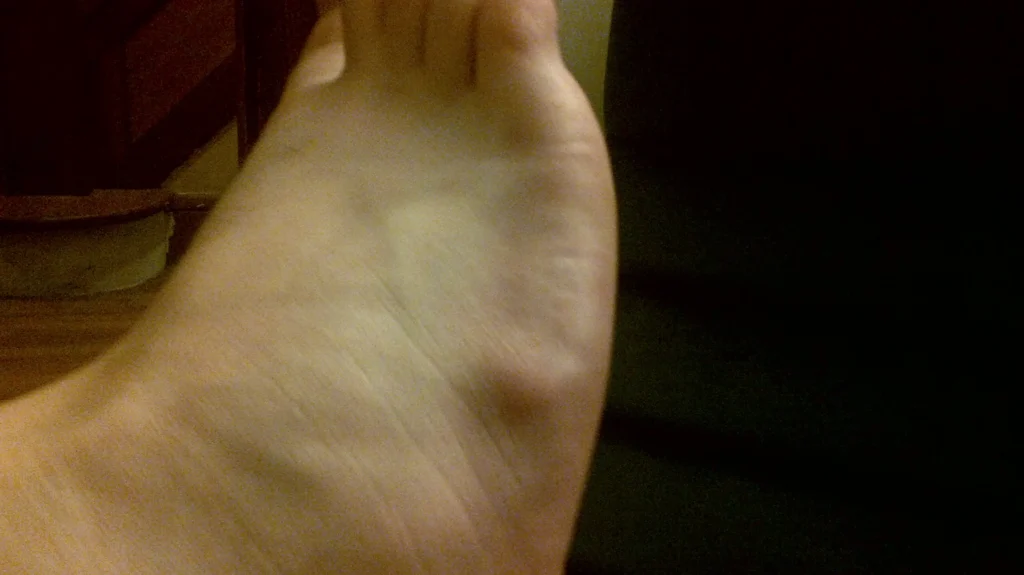
The most obvious symptom is often a visible or palpable lump.
But the symptoms can vary considerably.
A painless lump
Some cysts are discovered accidentally.
You may notice them while applying moisturizer, changing shoes or looking at your ankle after exercise.
If the cyst is small and painless, immediate intervention may not be necessary after an appropriate clinical assessment.
Local ankle pain
Pain may be dull, aching or pressure-related.
Some people experience pain only when the ankle moves into a particular position.
Others notice discomfort after walking or standing for a long time.
Pain when wearing shoes
This is an easily overlooked symptom.
A person may report, “My ankle hurts only in certain shoes.”
That does not necessarily mean the shoe is the original cause.
The shoe may simply be compressing an existing cyst.
A dorsal foot ganglion can become painful because footwear places direct pressure over the mass.
A feeling of pressure or fullness
The ankle can sometimes feel “tight” even when its range of motion appears normal.
This is particularly noticeable when the cyst is positioned near a joint or tendon and becomes compressed during movement.
Tingling, burning or numbness
This symptom deserves greater attention.
A cyst located close to a nerve can produce neurological symptoms.
For example, a ganglion in the tarsal tunnel can compress the posterior tibial nerve and produce symptoms into the sole of the foot.
Rare reports have also described ganglia compressing branches of the deep peroneal nerve around the ankle and dorsum of the foot.
This is one of the reasons I would not advise repeatedly massaging a painful lump when there is associated tingling or numbness.
Weakness
Weakness is uncommon but more concerning.
If a cyst compresses a motor nerve, a person may develop difficulty moving the foot or toes normally.
A rare but important example is foot weakness associated with peroneal nerve compression by a ganglion.
Can an Ankle Cyst Cause Nerve Pain?
Yes, although this is not the typical presentation.
The anatomy of the ankle makes this clinically important.
The tarsal tunnel contains the posterior tibial nerve and several tendons and blood vessels.
A cyst occupying this restricted space can contribute to nerve compression.
Patients may experience:
- Burning in the sole
- Tingling around the inner ankle
- Numbness in the foot
- Electric-shock-like pain
- Symptoms that increase after prolonged standing or walking
A published case report described an intraneural ganglion cyst involving the tibial nerve in the tarsal tunnel, demonstrating that cystic lesions can occasionally produce genuine compressive neuropathy rather than simple local soreness. (JOCR)
A newer clinical case report has also highlighted deep peroneal nerve compression by an ankle ganglion as an uncommon cause of dorsal foot pain.
These cases are rare, but they are important because nerve symptoms change the level of concern.
The Lesser-Known Reason a Small Cyst Can Hurt More Than a Large One
Size does not tell the whole story.
A 1 cm cyst positioned away from important structures may be almost completely painless.
A smaller lesion sitting beside a nerve can be much more symptomatic.
Think of it like luggage inside a crowded suitcase.
A small object placed in an empty corner causes little trouble.
The same object placed against a zipper or delicate item can become irritating.
The same principle applies to the ankle.
This is why imaging reports should be interpreted alongside the person’s symptoms rather than judged only by cyst dimensions.
How Is an Ankle Synovial Cyst Diagnosed?
Diagnosis starts with a physical examination.
Your clinician may assess:
- Exact location of the lump
- Size and consistency
- Whether it moves with the skin or deeper structures
- Pain on palpation
- Ankle range of motion
- Tendon function
- Joint stability
- Sensation
- Muscle strength
- Neurovascular status
- Relationship between symptoms and footwear or movement
Ultrasound
Ultrasound can be very useful for a superficial cyst.
It can help determine whether a lump is fluid-filled and can sometimes demonstrate its relationship to nearby tendons, nerves and vessels.
The American College of Radiology considers ultrasound an appropriate initial imaging option for many superficial soft-tissue masses.
An additional advantage is that ultrasound can examine a structure dynamically while the patient moves the ankle.
Recent research involving peripheral intraneural ganglion cysts found high agreement between ultrasound and MRI, although MRI performed better for visualization overall. (WILEY)
MRI
MRI becomes particularly useful when:
- The cyst is deep
- The diagnosis is uncertain
- Symptoms suggest nerve compression
- There is concern about tendon involvement
- Surgery is being considered
- Ultrasound is inconclusive
- The lesion appears atypical
MRI can show the cyst’s relationship with the joint, tendon, nerve and surrounding soft tissues.
This relationship can be more important than the cyst’s size alone.
Do You Always Need Treatment?
No.
A small, painless, clinically typical cyst may sometimes be monitored.
This is an important message because the word “cyst” can make people believe that something must immediately be removed.
That is not always true.
Evidence from ganglia in other body regions shows that spontaneous resolution can occur, although the natural history of ankle-specific cysts is less well established.
A 2023 prospective pediatric cohort found spontaneous resolution in approximately two-thirds of untreated hand and wrist ganglia. However, that study involved children and different anatomical locations, so those numbers should not be directly applied to adult ankle cysts. (Researchgate)
The appropriate approach is therefore observation when the lesion is confidently benign, symptoms are minimal and there are no concerning neurological or structural features.
Ankle Synovial Cyst Treatment
Treatment depends on symptoms, cyst location, recurrence and its relationship to surrounding structures.
1. Observation
Observation can be reasonable when:
- The cyst is painless
- It does not restrict movement
- There are no nerve symptoms
- It is not rapidly enlarging
- Imaging is reassuring
Your clinician may simply monitor it.
This is not “doing nothing.” It is choosing not to expose a minimally symptomatic condition to unnecessary invasive treatment.
2. Activity modification
If a particular activity repeatedly irritates the cyst, temporarily reducing that exposure can help.
For example, if running increases pressure around the cyst, switching temporarily to cycling, swimming or controlled walking may allow symptoms to settle.
However, complete rest is rarely necessary for every patient.
The goal is load modification, not fear of movement.
3. Footwear modification
This can be surprisingly effective when the cyst sits on the top or front of the ankle.
Consider:
- A wider toe box
- Softer shoe material over the cyst
- Less rigid uppers
- Avoiding pressure directly over the lump
- Loosening laces around the painful region
Do not simply buy a more cushioned shoe if the main problem is direct compression.
Sometimes the best shoe is the one that does not press on the cyst.
4. Physiotherapy
Physiotherapy does not “dissolve” every cyst.
That distinction is important.
A physiotherapist’s role is to determine whether the cyst is being aggravated by a broader mechanical problem and to restore function around it.
Treatment may include:
- Ankle mobility work
- Calf flexibility where appropriate
- Foot and ankle strengthening
- Proprioceptive training
- Balance exercises
- Gait retraining
- Gradual return to running
- Load-management education
- Footwear modification
- Addressing movement patterns that repeatedly provoke symptoms
If the cyst is asymptomatic and mechanically irrelevant, aggressive treatment directed at the cyst may be unnecessary.
A physiotherapy mistake to avoid
Do not assume every lump should be treated with deep friction massage.
A cyst adjacent to a nerve or blood vessel is not a normal tight muscle.
Repeated aggressive pressure can aggravate symptoms and may make it harder to determine what is actually happening.
If a lump is painful, firm, enlarging or associated with neurological symptoms, establish the diagnosis first.
Can a Synovial Cyst Be Aspirated?
Yes, in selected cases.
Aspiration involves inserting a needle into the cyst and removing its contents.
Sometimes medication is also injected.
However, aspiration does not necessarily eliminate the anatomical connection that produced the cyst.
That is why recurrence can occur.
The foot-and-ankle literature is not strong enough to promise that aspiration is a permanent solution.
In the 2022 scoping review, conservative approaches such as aspiration and steroid injection were reported in only a minority of included studies, while recurrence remained variable. (JCOT)
Aspiration may therefore be useful in carefully selected patients, but it should not be presented as a guaranteed cure.
Never attempt to puncture or drain an ankle cyst yourself.
The ankle contains important nerves, vessels and tendons, and not every lump is a cyst.
When Is Surgery Considered?
Surgery may be considered when:
- The cyst repeatedly recurs
- Pain remains significant
- The cyst interferes with footwear or walking
- There is persistent functional limitation
- A nerve is being compressed
- The cyst is associated with an underlying structural problem
- Conservative care has failed
- The diagnosis requires removal or tissue examination
Surgical treatment usually involves excision of the cyst, with attention to its origin or connecting structure where appropriate.
In a 53-case foot-and-ankle surgical series, lesions arose from different anatomical structures, including tendon sheaths and joints. This reinforces an important principle: removing only the visible “bubble” may not address the entire problem if a connection remains. (Science Direct)
Surgery can be effective, but it also has risks such as infection, scarring, nerve irritation, stiffness and recurrence.
The decision should therefore be based on symptoms and anatomy rather than appearance alone.
Why Do Ankle Cysts Come Back?
Recurrence is one of the most frustrating aspects of ganglion treatment.
The visible swelling may disappear, but the underlying connection can remain.
The foot-and-ankle scoping review found substantial variation in recurrence rates across studies, with a pooled recurrence rate of approximately 30.6%.
Surgical excision generally had lower recurrence than conservative treatment in the available literature, although the researchers emphasized that the overall evidence quality was low. (MDPI)
This is why a recurrence does not necessarily mean that the original treatment was “wrong.”
It may reflect the underlying anatomy.
Things to Do
- Get a persistent or changing ankle lump properly assessed.
- Choose footwear that does not directly compress the swelling.
- Maintain comfortable ankle movement.
- Progress ankle and calf strengthening gradually.
- Work on balance if previous ankle sprains have affected stability.
- Monitor changes in size, pain, sensation and movement.
Things to Avoid
- Do not puncture or drain the lump yourself.
- Do not try to crush a cyst with a heavy object.
- Avoid aggressive massage when there is numbness, tingling or electric pain.
- Do not ignore a rapidly enlarging or unusually hard lump.
- Do not assume every ankle swelling is a cyst.
- Do not stop all physical activity indefinitely without a clinical reason.
Things I Would Ask You Not to Do
Do not repeatedly press the lump
Trying to flatten it by force is unlikely to address its origin.
Do not hit it with a heavy object
Old-fashioned advice to “burst” a ganglion is not a safe modern treatment strategy.
Do not massage a lump that causes tingling
Neurological symptoms require assessment rather than increasingly aggressive manual treatment.
Do not ignore rapid growth
A rapidly changing mass deserves medical evaluation.
Do not assume every ankle swelling is a cyst
A proper diagnosis matters before treatment.
Do not stop all activity indefinitely
Once serious pathology has been excluded, controlled movement and appropriate loading can usually be incorporated into recovery.
Things You Can Do to Reduce Irritation
If your cyst has already been medically assessed as benign, practical measures include:
- Choose footwear that does not press directly on the lump.
- Reduce activities that repeatedly compress the area.
- Maintain comfortable ankle mobility.
- Strengthen the calf and ankle progressively when tolerated.
- Work on balance after previous ankle sprains.
- Increase running or walking volume gradually rather than suddenly.
- Monitor whether symptoms are mechanical or neurological.
- Keep track of changes in lump size and symptoms.
- Return for reassessment if the character of the swelling changes.
The aim is not necessarily to make the cyst disappear through exercise.
The aim is to make your ankle function normally without continually irritating the cyst.
When Should You See a Doctor Promptly?
Please seek medical assessment if an ankle lump:
- Grows quickly
- Becomes very painful
- Is associated with redness or significant warmth
- Appears after significant trauma
- Causes numbness or tingling
- Causes weakness
- Produces foot-drop symptoms
- Interferes substantially with walking
- Feels fixed or unusually hard
- Is associated with unexplained systemic symptoms
- Persists despite appropriate conservative care
Particular attention is warranted when a lump is accompanied by neurological symptoms.
Rare cases have demonstrated that ganglion cysts can compress the tibial or deep peroneal nerves and cause significant neuropathic symptoms.
A Physiotherapist’s Clinical Perspective
If you came to me with a lump around your ankle, I would not begin by asking, “Which exercise should we do?”
I would first ask:
What exactly is this lump?
Then:
Where did it come from, what structure is it connected to, and what is it doing to your movement?
Only after answering those questions would I decide whether physiotherapy, observation, aspiration, specialist referral or surgery makes sense.
This is particularly important because a cyst may be an incidental finding while the real cause of your ankle pain is tendon irritation, joint instability or another condition.
On the other hand, the cyst itself may be the source of symptoms if it is compressing a nerve or being repeatedly squeezed by footwear.
The best treatment is therefore not necessarily the most aggressive treatment.
It is the treatment that matches the anatomy.
Final Word
An ankle synovial cyst can be harmless, irritating or, rarely, neurologically significant.
A small painless lump may only need observation.
A cyst that is repeatedly compressed by footwear may respond to load and footwear modification.
Physiotherapy can help restore ankle strength, mobility, balance and movement confidence, but it should not be presented as a guaranteed method of dissolving the cyst.
Aspiration may provide relief but can be followed by recurrence.
Surgery can offer a more definitive solution in selected symptomatic or recurrent cases, particularly when the cyst has a clear anatomical connection or is compressing a nerve.
The biggest mistake is to treat every ankle lump the same way.
Before you try to remove the lump, find out what the lump actually is.
That single step can prevent unnecessary treatment and, in the uncommon case of nerve compression, help avoid prolonged neurological problems.
Frequently Asked Questions
1. What is an ankle synovial cyst?
An ankle synovial cyst is a fluid-filled swelling associated with a joint or synovial structure. Some lumps called synovial cysts are actually ganglion cysts that develop from a joint, tendon sheath or nearby soft tissue.
2. What does an ankle synovial cyst feel like?
It may feel like a small, smooth or firm lump around the ankle. Some cysts are completely painless, while others can cause aching, pressure, tenderness or discomfort during walking and ankle movement.
3. Can an ankle cyst cause pain when wearing shoes?
Yes. A cyst on the front, outer or top part of the ankle or foot may become painful when shoes repeatedly press against it. Changing to footwear that does not compress the lump may reduce irritation.
4. Can an ankle synovial cyst cause numbness or tingling?
Rarely, an ankle or foot cyst can press against a nearby nerve and cause tingling, numbness, burning or electric-shock-like pain. These symptoms should be medically assessed rather than treated with aggressive massage.
5. Can an ankle synovial cyst go away on its own?
Some ganglion cysts can become smaller or disappear without treatment, although the natural history of adult ankle cysts is not as well established as that of ganglia in the wrist and hand. A small, painless cyst may sometimes be monitored after appropriate assessment.
6. Does physiotherapy help an ankle synovial cyst?
Physiotherapy can help improve ankle mobility, strength, balance, walking mechanics and activity tolerance when these factors contribute to symptoms. However, physiotherapy should not be considered a guaranteed way to dissolve or remove the cyst itself.
7. Can an ankle cyst be treated without surgery?
Depending on the cyst and its symptoms, treatment may include observation, activity modification, footwear changes, physiotherapy or aspiration. Surgery may be considered when the cyst is painful, recurrent, functionally limiting or compressing a nerve.
8. Can an ankle synovial cyst come back after treatment?
Yes. Recurrence is possible because the cyst may remain connected to a joint or tendon-related structure. Removing or draining the visible cyst does not always eliminate the underlying source of fluid.
9. Should I massage or press an ankle cyst?
Avoid aggressively pressing, crushing or repeatedly massaging an undiagnosed ankle lump. This is particularly important if you have numbness, tingling, burning pain or other signs that a nearby nerve may be involved.
10. When should I see a doctor about an ankle cyst?
Get the lump assessed if it grows quickly, becomes significantly painful, feels unusually hard, causes numbness or weakness, interferes with walking, develops redness or warmth, or persists without a clear diagnosis.
Stay tuned with us for more health related topics.
Follow us on LinkedIn and Instagram for more.
More Read



Medical Disclaimer!
This article has been reviewed and written under the guidance of our Head Physiotherapist, Dr. Kruti Raj (PT, MUHS,CPT,CMPT). The information shared is intended for educational purposes only and should not be considered a substitute for personalized medical advice, diagnosis, or treatment.
Please consult us or any other qualified healthcare professional before beginning any exercise program, especially if you are experiencing pain, recovering from injury, or managing a medical condition.