


Most people who walk into a physiotherapy clinic with headaches don’t think their neck is the problem, which is why manual therapy for headache relief is often overlooked.
They usually say:
- “It starts in the evening”
- “Pain goes from neck to head”
- “Tablets help but it comes back again”
That last line is important.
If a headache keeps coming back, it usually means one thing, the root cause is still there
And in many cases, that root cause is not inside the head. It is in the neck, muscles, joints, and movement patterns
Manual therapy helps relieve headaches by reducing muscle tightness, improving neck joint movement, and calming pain signals. It works best for neck-related headaches and gives faster relief when combined with simple exercises and daily habit changes.
- Many headaches actually start from the neck, not the head
- Manual therapy provides quick relief but is not a standalone fix
- Trigger points can refer pain to temples, eyes, and back of the head
- Exercises and movement correction are essential for long-term results
- Daily habits like screen use and posture play a major role
- Consistency matters more than the number of therapy sessions
What is manual therapy really
Manual therapy is often misunderstood as just massage.
It is not.
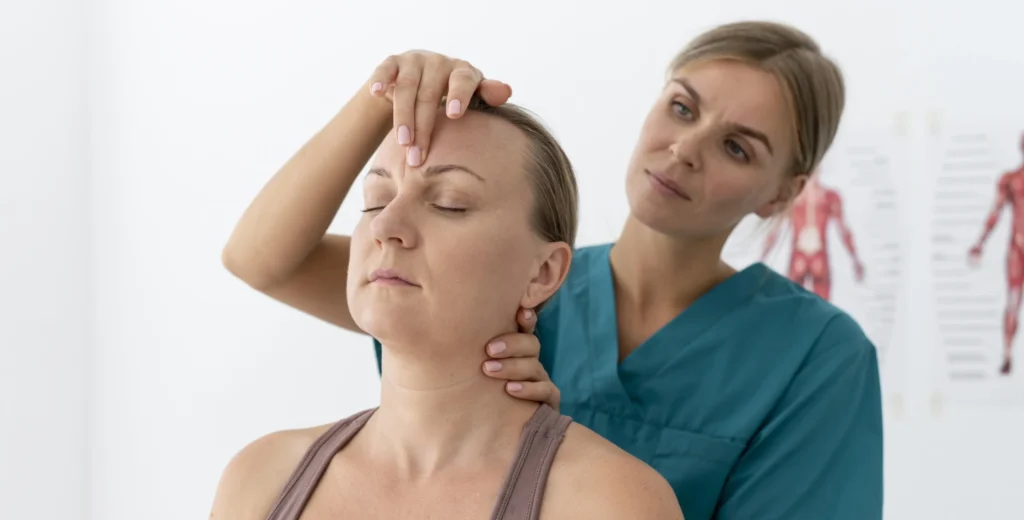
It is a structured, clinical approach where a physiotherapist uses hands to:
- Improve joint movement
- Reduce muscle tension
- Release trigger points
- Modify pain signals
Think of it as correcting the system instead of masking symptoms
Which headaches actually respond to manual therapy
Not every headache needs hands-on treatment.
But these commonly do:
Tension-type headaches
- Tight band feeling around head
- Neck and shoulder stiffness
- Worse after long work hours
Cervicogenic headaches
- Starts from neck
- Moves to one side of head
- Neck movement is restricted
Postural headaches
- Common in desk workers
- Linked to screen time and poor control, not just posture
Who benefits most from manual therapy
You are more likely to benefit if:
- you have desk job or long sitting hours
- your headache starts from the neck
- you feel stiffness along with pain
- stress increases your symptoms
- you get temporary relief from massage
How to know if your headache is coming from your neck
Not every headache is neck-related. But there are some simple clues.
You might notice:
- Pain starts in the neck and travels upward
- One side is more painful than the other
- Turning your neck increases the headache
- Pressing certain spots in your neck triggers pain in your head
- Headache is worse after long sitting or screen time
A simple test I tell patients:
Sit straight and slowly turn your head side to side
If:
- movement feels restricted
- or it triggers your headache
There is a good chance your neck is involved.
What is really happening inside the body
Here is something most people are never told.
The upper neck shares nerve pathways with the head.
This is why:
- Neck pain can feel like head pain
- Treating only the head does not solve the issue
This mechanism is explained through trigeminocervical convergence, where signals from the neck and head overlap.
How manual therapy helps in real terms
Let’s keep this simple and practical.
1. It reduces muscle overload
Certain muscles are almost always involved:
- Upper trapezius
- Levator scapulae
- Suboccipital muscles
When they stay tight for long, they create constant tension.
Manual release reduces that load.
2. It improves joint movement
Small joints in the upper neck can become stiff.
This stiffness alters movement and increases stress.
Manual therapy helps restore normal motion.
3. It changes how the brain perceives pain
This is often ignored.
Hands-on therapy provides strong sensory input.
This can temporarily reduce pain sensitivity. Bialosky et al., 2009
4. It releases trigger points
Trigger points are not just local knots. Fernández-de-las-Peñas et al., 2006
They can refer pain to:
- temples
- behind eyes
- back of head
Important truth most people are not told
Manual therapy is helpful. But it is not the full solution
Relief from hands is temporary if the underlying cause is not corrected. Research consistently shows better results when manual therapy is combined with exercise. Gross et al., 2015
Manual therapy vs exercise vs medication
Each has a role. But they work differently.
Manual therapy
- gives quick relief
- improves movement
- prepares body for rehab
Exercise
- builds long-term stability
- prevents recurrence
Medication
- reduces symptoms temporarily
- does not fix cause
Best results usually come from combining all three when needed.
What actually creates long-term relief
This is where real change happens.
1. Deep neck muscle control
Most people stretch the neck.
Very few train it correctly.
Weak deep neck muscles shift load to superficial muscles.
That leads to recurring headaches. Jull et al., 2002
2. Scapular stability
Your neck is supported by your shoulder girdle.
If the shoulder blade is unstable, the neck compensates.
3. Breathing pattern
Shallow chest breathing overactivates neck muscles.
This keeps tension constant throughout the day.
4. Load management
Long sitting hours without breaks overload the system.
Even perfect posture cannot handle constant stress.
Techniques used in manual therapy
Not all techniques are the same.
Joint mobilization
Gentle, controlled movements to improve joint function.
Soft tissue release
Pressure applied to tight muscles to reduce tension.
Trigger point therapy
Focused pressure on pain points that refer symptoms.
Myofascial release
Slow, sustained technique for deeper restrictions.
Muscle energy techniques
Combination of patient effort and therapist guidance.
What you might feel after a session
Patients often report:
- head feels lighter
- reduced pressure
- easier neck movement
Some soreness can happen the next day. That is normal.
What happens during your first physiotherapy session
Many people are unsure what to expect.
A proper session usually includes:
Assessment first
- posture check
- neck movement testing
- muscle tightness evaluation
Hands-on treatment
- based on findings, not random massage
Movement correction
- simple exercises given immediately
Education
- what caused your headache
- what to avoid
A good session should leave you with clarity, not confusion
What recent research says
Manual therapy has good evidence, but with conditions.
Short-term relief is strong.
Long-term improvement depends on exercise and habits.
Systematic review shows moderate evidence for reducing headache intensity and frequency. Luedtke et al., 2022
Recent trials also support combining manual therapy with exercise for better outcomes. González-Iglesias et al., 2024
Lesser-known factors that influence headaches
These are often missed.
Jaw tension
Clenching increases neck load.
Pillow height
Too high or too low changes neck alignment.
Hydration
Low hydration increases muscle sensitivity.
Eye strain
Often mistaken as eye problem but originates from neck.
Stress response
Increases muscle guarding without you realizing it.
Common mistakes that keep headaches coming back
I see this all the time.
People do the right treatment but still don’t improve.
Here’s why:
- Only taking treatment, not doing exercises
- Stretching too much but not strengthening
- Ignoring work habits
- Using random pillows without checking comfort
- Waiting for pain instead of preventing it
The biggest mistake:
depending only on passive treatment
When manual therapy may not help much
Being realistic is important.
Limited benefit in:
- migraine-dominant headaches
- hormonal headaches
- severe sleep issues
- high stress without lifestyle change
When a headache needs medical attention first
Most headaches are harmless. But some signs should not be ignored.
Seek medical advice if you notice:
- Sudden severe headache unlike before
- Headache with dizziness, vision issues, or speech difficulty
- Headache after a fall or injury
- Persistent morning headaches
- Fever with headache
These are not cases to self-treat or try manual therapy first.
A simple daily routine that actually works
Not complicated. Just consistent.
Morning
- gentle neck movements
- chin tuck activation
During work
- break every 30 to 40 minutes
- reset posture and movement
Evening
- shoulder and neck control exercises
Night
- proper pillow height
- reduce screen exposure
How long does it take to see results
This depends on the condition.
From clinical experience:
- mild cases improve in 1 to 2 sessions
- moderate cases take 3 to 6 sessions
- chronic cases need longer and consistent effort
Important point:
Relief can be quick. Correction takes time
What I tell patients in clinic
If you depend only on passive treatment, the problem keeps returning.
If you combine:
- manual therapy
- movement correction
- strength
- awareness
Then the need for treatment gradually reduces. That is the real goal.
A quick real-life example
A 32-year-old IT professional came with daily evening headaches.
Pain started from the neck and moved to the right side of the head.
What we found:
- poor neck control
- tight upper trapezius
- long screen hours without breaks
Treatment included:
- manual therapy for relief
- deep neck exercises
- simple work habit changes
Within 2 weeks:
- headache frequency reduced significantly
What made the difference was not just treatment. It was what he did between sessions.
Frequently Asked Questions
1. Is manual therapy safe for headaches?
Yes, it is generally safe when performed by a qualified physiotherapist after proper assessment.
2. How many sessions do I need to see results?
Most people notice improvement within 3 to 5 sessions, but chronic cases may take longer.
3. Can manual therapy permanently cure headaches?
It helps reduce symptoms, but long-term relief depends on exercises, posture, and lifestyle changes.
4. Does manual therapy hurt?
You may feel mild discomfort during treatment, but it should not be painful.
5. Is manual therapy useful for migraines?
It may help reduce triggers related to the neck but is not a primary treatment for migraines.
6. Why do my headaches come back after treatment?
Because the root cause such as poor movement, stress, or habits is not corrected.
7. Can I do manual therapy at home?
Basic techniques can help, but proper assessment and treatment should be done by a professional.
Stay tuned with us for more health related topics.
Follow us on LinkedIn and Instagram for more.
More Read


Medical Disclaimer!
This article has been reviewed and written under the guidance of our Head Physiotherapist, Dr. Kruti Raj (PT, MUHS,CPT,CMPT). The information shared is intended for educational purposes only and should not be considered a substitute for personalized medical advice, diagnosis, or treatment.
Please consult us or any other qualified healthcare professional before beginning any exercise program, especially if you are experiencing pain, recovering from injury, or managing a medical condition.


