


Is Your SI Joint Causing Back Pain? Learn Best Sacroiliac joint pain exercises
If you have persistent pain on one side of your lower back, especially around the upper buttock, you may have wondered whether the problem is your spine, a slipped disc, your hip, or something else entirely.
There is another structure that deserves attention: the sacroiliac (SI) joint.
The SI joints sit between the sacrum at the bottom of your spine and the two pelvic bones.
They form an important link between your upper body and your legs, helping transfer forces when you walk, climb stairs, run, bend, or stand on one leg.
SI joint pain is estimated to account for roughly 15% to 30% of mechanical low back pain, although exact estimates vary because diagnosing the joint is surprisingly difficult. (PMC)
Quick Answer
Yes. The sacroiliac (SI) joint can contribute to lower back and buttock pain, particularly when pain is felt on one side below the lumbar spine. However, SI joint pain can closely resemble pain from the lumbar spine or hip. A physiotherapist usually combines your symptom history, lumbar and hip examination, and several SI joint provocation tests rather than relying on one test or an MRI alone.
As a physiotherapist, I want to make one point clear from the beginning: not every pain near the SI joint is actually coming from the SI joint.
That distinction is extremely important.
You can have pain in the exact location of the SI joint because of the lumbar spine, hip, surrounding muscles, ligaments, or even an inflammatory condition.
Conversely, genuine SI joint pain can sometimes mimic sciatica or other types of low back pain.
So rather than trying to “put your SI joint back into place,” the better question is:
Does your pattern of symptoms actually suggest that the SI joint is contributing to your pain?
Let us look at what the research and modern physiotherapy tell us.
Key Takeaways
- SI joint pain may account for approximately 15% to 30% of mechanical low back pain.
- Pain near the SI joint does not automatically mean the SI joint is the source.
- Three or more positive provocation tests can provide useful clinical evidence, but no test is perfect.
- MRI and X-rays generally cannot prove that the SI joint is causing mechanical pain.
- Exercise, progressive strengthening, movement retraining and education are important components of physiotherapy.
- Manual therapy may help some patients, but it should not be the entire rehabilitation strategy.
- Pregnancy, trauma, inflammatory disease and previous lumbar surgery can be relevant risk factors.
- Persistent or severe symptoms should be assessed professionally, particularly when red flags are present.
What Exactly Is the Sacroiliac Joint?
You have two SI joints, one on either side of your sacrum.
They connect the triangular sacrum at the base of the spine with the left and right ilium, which are the large pelvic bones.
Unlike the knee or shoulder, the SI joint is not designed for large, obvious movements.
Its primary job is load transfer and force management.
When you walk, for example, forces travel from your feet through your legs and pelvis toward your spine.
The SI joints help distribute those forces between the trunk and lower limbs.
The joint is reinforced by some of the strongest ligaments in the body.
Interestingly, the SI joint moves far less than many people imagine.
A detailed biomechanical review estimates only a few degrees of movement during flexion-extension, with even smaller amounts during rotation and side bending. (PubMed)
This leads to an important lesser-known fact:
SI joint dysfunction does not necessarily mean that the joint is dramatically “out of alignment.”
In fact, the popular idea that your pelvis repeatedly slips out of place and needs to be manually “put back” oversimplifies a very complicated pain system.
Can the SI Joint Really Cause Back Pain?
Yes.
But identifying it as the pain generator is not always straightforward.
SI joint pain commonly occurs below the level of the lumbar spine and may be felt around the buttock, posterior pelvis, lateral hip, groin, or occasionally further down the leg.
Some people describe:
- One-sided lower back pain
- Deep buttock pain
- Pain near the dimples above the buttocks
- Pain when climbing stairs
- Pain when getting out of a chair
- Discomfort when turning in bed
- Pain while standing on one leg
- Pain during prolonged standing
- Pain when walking for longer periods
- Discomfort during running or cutting movements
The symptoms can overlap considerably with lumbar spine and hip disorders.
That is why location alone cannot diagnose SI joint dysfunction.
A 2021 systematic review found that even clusters of SI joint pain-provocation tests have limitations.
A positive cluster increased the probability of SI joint pain, but the evidence was not strong enough to confidently “rule in” the SI joint based on testing alone. (JOSPT)
That is one of the most important findings patients should know.
The Fortin Finger Test: A Useful Clue, Not a Diagnosis
One simple clinical clue is the Fortin finger test.
A patient is asked to point with one finger to the area where the pain is strongest.
If you consistently point to the region just inferomedial to the posterior superior iliac spine, the SI joint becomes one possible pain source.
But this is a clue rather than proof.
Your physiotherapist should combine your symptom history, lumbar examination, hip examination, neurological assessment, movement analysis, and SI joint provocation testing rather than relying on one location test.
Why SI Joint Pain Is So Easily Misdiagnosed
Here is something many online articles miss:
The SI joint is not isolated from the rest of the lumbopelvic system.
Your lumbar spine, hips, pelvis, abdominal muscles, gluteal muscles, pelvic floor, and surrounding connective tissues interact during movement.
For example, pain around the SI region could be associated with:
- Lumbar disc-related pain
- Facet joint pain
- Hip pathology
- Greater trochanteric pain syndrome
- Gluteal tendinopathy
- Piriformis-region pain
- Pelvic girdle pain
- Inflammatory sacroiliitis
- Stress injury
- Fracture
- Neurological disorders
This is why a good SI joint assessment begins by asking:
“What else could produce this pattern?”
rather than immediately assuming the SI joint is responsible.
What Causes Sacroiliac Joint Dysfunction?
There is rarely one universal cause.
SI joint symptoms may develop after an injury, repetitive loading, pregnancy, changes in movement patterns, previous spinal surgery, or degeneration.
Some recognized associations include trauma, pregnancy, inflammatory arthritis, previous lumbar fusion, and leg-length differences.
Sudden twisting or trauma
A fall, awkward landing, car accident, sports collision, or sudden twisting movement can irritate structures around the SI joint.
You may notice symptoms immediately or develop them over the following day.
Repetitive asymmetric loading
Running, jumping, kicking, prolonged standing on one leg, or repeatedly carrying loads on one side can increase asymmetric loading through the pelvis.
That does not mean asymmetry is automatically harmful.
Human bodies are naturally asymmetrical.
The important question is whether a particular movement repeatedly reproduces your symptoms.
Pregnancy and postpartum changes
Pregnancy deserves special attention.
Hormonal, mechanical, and behavioral changes can influence the pelvic region during pregnancy and after childbirth.
Pregnancy-related pelvic girdle pain can involve the SI joints, although it should not automatically be interpreted as simply “loose joints.”
Research has found increased pelvic joint movement in some women with pregnancy-related lumbopelvic pain, but the overlap with healthy women is too large for joint mobility alone to diagnose pain. (Acta Obstet Gynecologica Scandinavica)
This is a subtle but important distinction.
More movement does not automatically equal more pain.
Previous lumbar fusion
Another lesser-known association is previous lumbar spinal fusion.
Changing how forces are distributed through the lumbopelvic region may increase mechanical demands around the SI joint in some people.
If SI-region pain develops after spinal surgery, it deserves a proper assessment rather than assuming the problem is simply muscular.
Does Leg Length Difference Cause SI Joint Pain?
This is another area where internet advice can become unnecessarily dramatic.
A true leg-length difference can influence pelvic mechanics and has been identified as one possible predisposing factor for SI joint pain.
But not every difference requires a shoe lift.
There is an important distinction between:
True leg-length discrepancy: an actual difference in bone length.
Functional or apparent discrepancy: the legs appear different because of pelvic position, muscle tension, movement strategy, or other factors.
A physiotherapist should determine whether a difference is clinically meaningful before recommending correction.
Simply placing a heel lift under one shoe because your pelvis “looks tilted” can sometimes make symptoms worse rather than better.
How Does a Physiotherapist Diagnose SI Joint Dysfunction?
A proper assessment is much more comprehensive than pressing around the pelvis.
I would typically look at:
1. Your pain history
We want to know:
- Where exactly is your pain?
- Did it start suddenly or gradually?
- Was there an injury?
- Is it one-sided or both sides?
- Does sitting aggravate it?
- Does standing aggravate it?
- Is walking painful?
- Does turning in bed reproduce symptoms?
- Do stairs bother you?
- Do you have numbness or weakness?
- Has your pain changed over time?
These details help separate SI-region pain from other diagnoses.
2. Lumbar spine examination
Your lumbar spine must be assessed because disc and facet-related pain can mimic SI joint symptoms.
3. Hip examination
Hip problems can refer pain toward the buttock and lower back.
Ignoring the hip can therefore lead to an incorrect SI joint diagnosis.
4. Neurological screening
If you have leg weakness, altered sensation, reflex changes, or other neurological findings, your clinician should investigate possible nerve involvement.
5. SI joint provocation tests
Common tests include:
- Thigh thrust
- Distraction test
- Compression test
- Gaenslen test
- Sacral thrust
A commonly used clinical approach considers three or more positive provocation tests as stronger evidence than a single positive test.
However, newer research urges clinicians to interpret even test clusters cautiously.
A 2021 meta-analysis found that a positive cluster did not provide enough certainty to confidently confirm SI joint pain, although a negative cluster was more useful for ruling it out. (JOSPT)
This is exactly why I would never diagnose SI joint dysfunction from one test performed at home.
Do You Need an MRI or X-Ray?
Usually, not simply to “see whether your SI joint is out.”
This is another common misconception.
MRI, CT, and other imaging methods may help identify inflammatory disease, fracture, infection, tumor, or other conditions, but routine imaging does not reliably identify the SI joint as the exact source of mechanical pain.
In other words:
A scan can show anatomy without proving that the abnormality is causing your pain.
This is a fundamental principle in musculoskeletal physiotherapy.
We treat the patient, not merely the scan.
What Is the Best Treatment for SI Joint Dysfunction?
For most people, conservative care should come first.
The strongest practical approach is usually individualized exercise, education, movement modification, and manual therapy when appropriate.
The goal is not simply to “realign” your pelvis.
The goal is to improve your ability to tolerate load and movement without repeatedly provoking symptoms.
Physiotherapy Exercises for SI Joint Pain
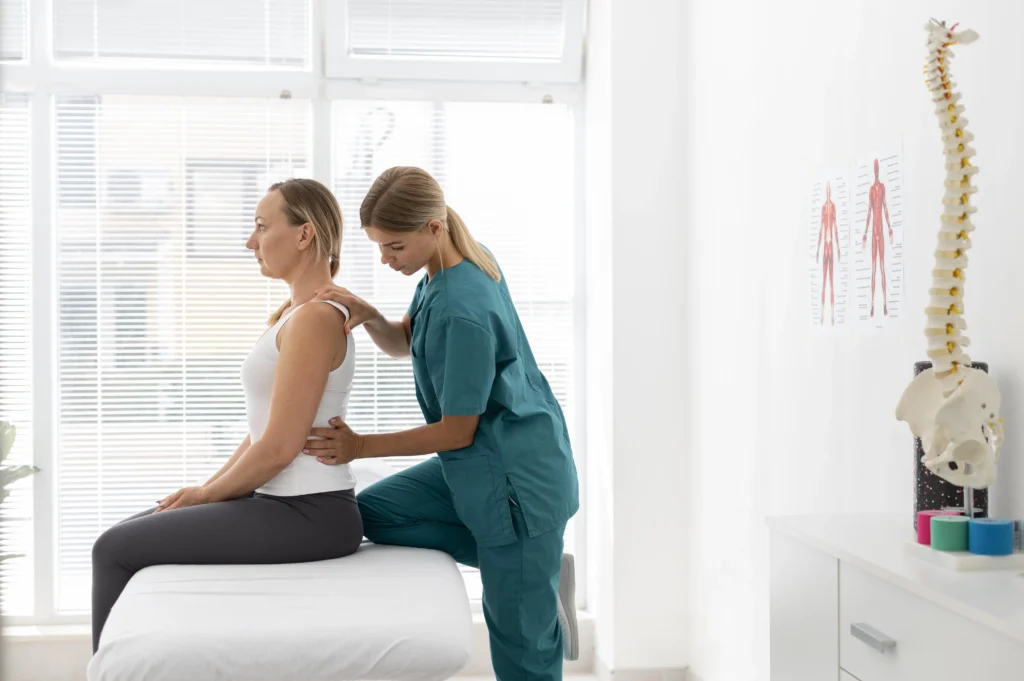
Your exercise program should be individualized, but several categories commonly make sense.
Core and trunk control
Exercises that improve control of the trunk and pelvis can help distribute loads more effectively.
Examples may include:
- Modified dead bugs
- Bird dogs
- Side-lying hip strengthening
- Pallof presses
- Controlled bridges
The important point is progression.
If a basic bridge is comfortable, that does not mean you should immediately perform hundreds of repetitions.
Your tissues need an appropriate dose of loading.
Gluteal strengthening
The gluteus maximus and gluteus medius contribute significantly to pelvic and hip control.
Depending on your presentation, exercises may include:
- Glute bridges
- Hip abduction
- Side steps
- Sit-to-stand exercises
- Step-ups
- Single-leg control exercises
The goal is not to “activate a sleeping muscle.”
The goal is to improve strength, endurance, coordination, and confidence during functional movement.
Balance and motor-control training
This is an area that deserves more attention.
A 2023 randomized controlled trial involving 120 participants investigated motor-control exercise and balance training for SI joint dysfunction. (MDPI)
The researchers found improvements in pain, disability, and quality-of-life outcomes, with combined training showing promising results.
This makes clinical sense because daily activities rarely involve isolated muscles.
Your pelvis has to respond to changing loads while you walk, turn, climb stairs, and shift weight.
Mobility work
Stretching may be useful when specific restrictions contribute to your symptoms.
But stretching everything around your pelvis is not automatically better.
A physiotherapist should identify whether restricted hip mobility, muscle stiffness, or movement behavior is actually relevant to your pain.
Does Manual Therapy Help SI Joint Dysfunction?
It can.
But I would not describe manual therapy as “putting your pelvis back into place.”
Manual therapy may temporarily reduce pain, improve movement confidence, and make exercise easier.
A randomized controlled trial comparing manipulation and stabilization exercises found improvements in both groups, without a significant difference between them. (Elsevier)
Another randomized trial found that exercise and manipulation both improved pain and disability, while their combination was not clearly superior over longer follow-up. (Sage Journals)
This tells us something clinically valuable:
Hands-on treatment can be useful, but it should not become the entire rehabilitation plan.
If you feel better only when someone repeatedly “adjusts” your pelvis, but symptoms return every few days, your rehabilitation strategy may need to include more active capacity-building.
What Does Recent Physiotherapy Research Say?
A 2025 systematic review and meta-analysis examined randomized controlled trials involving physiotherapy interventions for SI joint dysfunction. (NCBI)
It reported significant improvements in pain with muscle energy techniques, mobilization, and exercise, while exercise also produced improvements in disability.
This supports a broader physiotherapy principle:
Different people may respond to different combinations of treatment.
There is no universal SI joint exercise.
Your program should depend on your irritability, strength, mobility, activity level, work demands, and specific movement triggers.
Things I Would Ask You to Avoid
Stop repeatedly testing your SI joint at home
If you repeatedly perform provocative maneuvers to check whether the joint still hurts, you may simply keep irritating the painful area.
Testing should not become your exercise program.
Do not chase perfect pelvic symmetry
Your pelvis does not need to look perfectly level.
Small asymmetries are common in healthy humans.
The objective is better function and less pain, not geometric perfection.
Do not aggressively stretch an already irritated region
More stretching is not always better.
If a movement repeatedly increases your symptoms, reduce the intensity, range, or frequency and reassess.
Avoid prolonged bed rest
Pain can make you want to stop moving.
But prolonged inactivity can reduce physical capacity and confidence.
Unless a healthcare professional has specifically advised otherwise, gradual movement is generally preferable to complete avoidance.
Do not rely exclusively on a belt or brace
Pelvic belts may help selected postpartum patients, but they should generally be viewed as an aid rather than a permanent solution. (Research Gate)
A Lesser-Known Tip: Change How You Load the Pelvis
Sometimes the problem is not one exercise.
It is the accumulation of small asymmetric loads throughout the day.
For example, you might:
- Always stand on the same leg while brushing your teeth
- Carry a child on one hip
- Sit with one leg tucked underneath you
- Always cross the same leg
- Carry your laptop bag on one shoulder
- Sleep in one position for prolonged periods
- Repeatedly climb stairs using the same movement strategy
None of these behaviors automatically causes SI joint dysfunction.
But if one repeatedly reproduces your symptoms, changing the behavior temporarily may reduce the overall irritation.
Think of rehabilitation as managing your total load, not hunting for one “bad posture.”
When Should You See a Physiotherapist?
Consider an assessment if your back or buttock pain:
- Persists for several weeks
- Keeps returning
- Limits walking or exercise
- Makes stairs difficult
- Interferes with sleep
- Develops after an injury
- Is associated with hip or pelvic symptoms
- Is not improving with sensible self-care
A physiotherapist can determine whether the SI joint is actually a likely contributor or whether another structure deserves more attention.
When Is SI Joint Pain a Red Flag?
Not every case is mechanical.
Seek prompt medical evaluation if back or pelvic pain is accompanied by symptoms such as:
- Fever or unexplained illness
- Unexplained weight loss
- Significant trauma
- History of cancer
- Severe or progressive neurological symptoms
- New bowel or bladder changes
- Saddle-region numbness
- Severe night pain that is unusual for you
- Symptoms suggesting inflammatory arthritis
These findings require a broader medical assessment rather than simply treating the area as “SI joint dysfunction.”
What About SI Joint Injections?
For persistent symptoms where the diagnosis remains uncertain, an image-guided local anesthetic injection may sometimes be used diagnostically.
However, injections are not a magic diagnostic test either.
Recent reviews point out that false-positive and false-negative results can occur.
Injections may also be considered therapeutically in selected patients who do not respond adequately to conservative care.
These decisions belong with an appropriately qualified physician or pain specialist.
When Is Surgery Considered?
Surgery is not the starting point for typical SI joint pain.
For carefully selected patients with chronic, confirmed SI joint pain who have failed appropriate conservative and interventional treatment, minimally invasive SI joint fusion may be considered.
Randomized trials have found greater improvements in pain and disability after minimally invasive fusion than conservative management in selected patients.
For example, a 2019 randomized trial reported substantially greater two-year improvements following SI joint arthrodesis. (PMC)
But these results should not be interpreted as meaning surgery is necessary for ordinary SI-region back pain.
Patient selection is critical.
The Biggest Myth About SI Joint Dysfunction
The myth I most want patients to stop believing is:
“My SI joint keeps slipping out, so I need someone to put it back.”
The SI joint is a strong, highly ligamentous joint designed for transferring load.
Pain does not necessarily mean that the joint has physically moved out of position.
Modern pain science also reminds us that pain is influenced by much more than mechanical tissue position.
Sleep, stress, previous pain experiences, activity levels, fear of movement, recovery, and the sensitivity of the nervous system can all influence how symptoms behave.
That does not mean your pain is imaginary.
It means your rehabilitation needs to consider the whole person.
My Physiotherapy Approach to SI Joint Pain
If you came to my clinic with suspected SI joint pain, I would not start by trying to “realign” you.
I would first establish whether your symptoms actually fit an SI joint pattern.
Then I would:
1. Screen for red flags and competing diagnoses.
2. Examine your lumbar spine and hips.
3. Use a cluster of SI joint provocation tests when appropriate.
4. Assess strength, movement control, balance, and functional loading.
5. Identify the activities that repeatedly provoke your symptoms.
6. Reduce unnecessary aggravating loads temporarily.
7. Build your strength and movement capacity progressively.
8. Use manual therapy when it provides a useful short-term window for movement or exercise.
9. Gradually return you to your normal activities.
That approach is considerably more useful than repeatedly chasing pelvic alignment.
Final Word
So, can sacroiliac joint dysfunction cause back pain?
Absolutely.
But SI joint pain is not something you should diagnose simply because your pain happens to be near the dimples above your buttocks.
The SI joint can produce genuine, sometimes persistent pain, but its symptoms overlap with lumbar spine, hip, neurological, muscular, and inflammatory conditions.
The best diagnosis comes from combining your history with a thorough physical examination rather than relying on one home test or an imaging scan.
And the encouraging news is that most people do not need surgery.
A well-designed physiotherapy program focusing on appropriate loading, trunk and hip strength, motor control, balance, education, and gradual return to activity can be an important part of recovery.
Research supports exercise and other conservative approaches, while manual therapy can be useful as part of a broader rehabilitation strategy.
Your goal should not be to keep your pelvis perfectly aligned every minute of the day.
Your goal is to build a body that can tolerate real life again.
That is a much more practical definition of recovery.
Frequently Asked Questions
What does SI joint pain feel like?
SI joint pain is commonly felt on one side of the lower back or deep in the buttock. It may also spread toward the hip, groin or upper leg.
How do I know if my SI joint is causing my back pain?
You cannot reliably diagnose SI joint pain from location alone. A physiotherapist usually combines your history with lumbar, hip and SI joint examination and several provocation tests.
Can SI joint dysfunction cause sciatica-like pain?
SI joint pain can sometimes refer into the buttock or leg and resemble other conditions. True nerve-related sciatica should be appropriately screened for during assessment.
Is walking good for SI joint pain?
Walking can be beneficial when tolerated. If walking significantly increases symptoms, temporarily reducing distance or speed and gradually rebuilding tolerance may be more appropriate.
What exercises are good for SI joint dysfunction?
Depending on your assessment, exercises may include bridges, hip strengthening, trunk-control exercises, bird dogs, balance training and functional strengthening.
Can a chiropractor or physiotherapist put the SI joint back into place?
Manual therapy can sometimes reduce pain and improve movement, but SI joint pain should not be explained simply as the joint repeatedly slipping out of place.
Does pregnancy cause SI joint problems?
Pregnancy can contribute to pelvic girdle and SI-region pain because of changing mechanical, hormonal and functional demands. Assessment is important because pregnancy-related pelvic pain has multiple contributing factors.
Do I need an MRI for SI joint dysfunction?
Not necessarily. Imaging is often used when clinicians need to investigate other conditions rather than simply confirm mechanical SI joint pain.
Can SI joint dysfunction be treated without surgery?
Yes. Conservative management, particularly individualized exercise and physiotherapy, is generally considered first-line care for most patients.
When should I see a doctor for SI joint pain?
Seek medical assessment for persistent, severe or worsening pain, especially if you have fever, unexplained weight loss, significant trauma, progressive weakness, bowel or bladder changes or other concerning symptoms.
Stay tuned with us for more health related topics.
Follow us on LinkedIn and Instagram for more.
More Read


Medical Disclaimer!
This article has been reviewed and written under the guidance of our Head Physiotherapist, Dr. Kruti Raj (PT, MUHS,CPT,CMPT). The information shared is intended for educational purposes only and should not be considered a substitute for personalized medical advice, diagnosis, or treatment.
Please consult us or any other qualified healthcare professional before beginning any exercise program, especially if you are experiencing pain, recovering from injury, or managing a medical condition.


